

Character info
The character
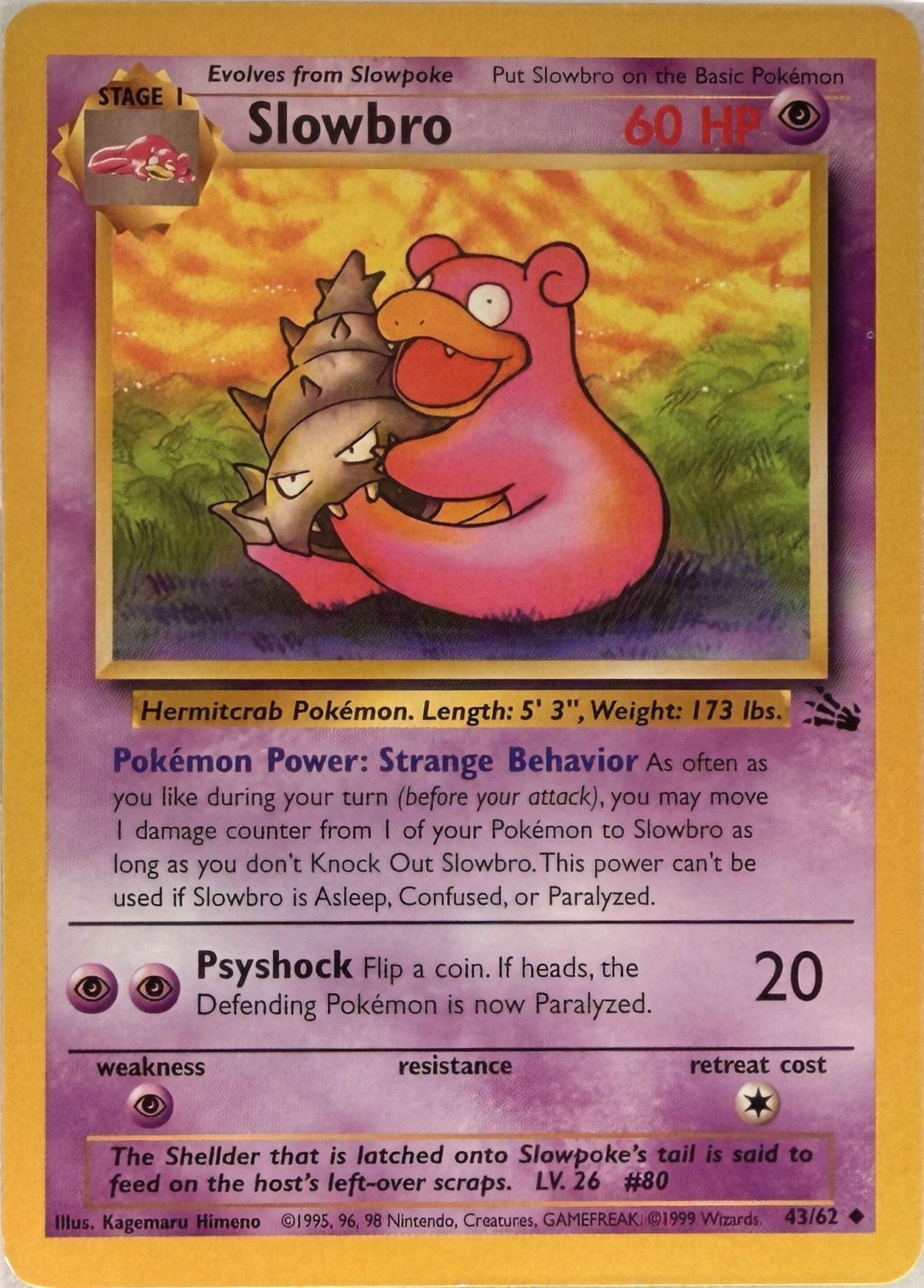
Slowbro is a Psychic/Water-type Pokémon that evolves from Slowpoke when a Shellder latches onto its tail. Known as the Hermitcrab Pokémon, it is depicted as sluggish and absent-minded, with the Shellder feeding off its host's leftover scraps. It is a well-known member of the original 151 Pokémon.
This card
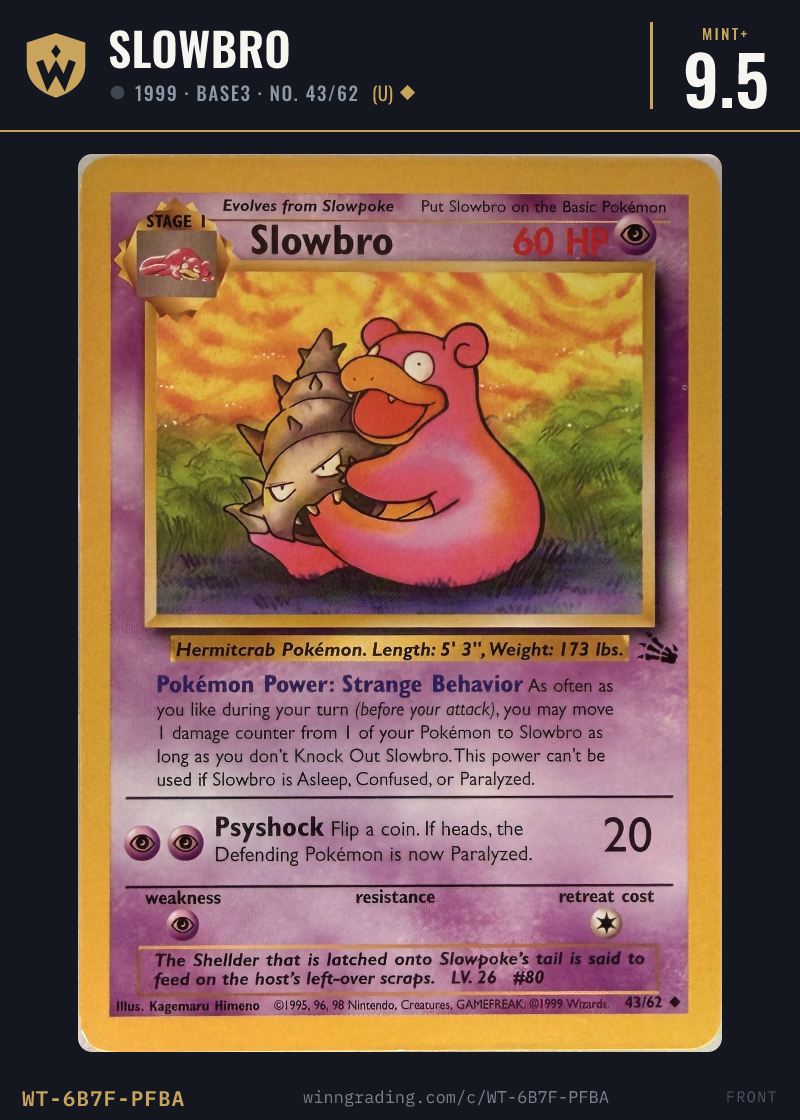
This is Slowbro from the Fossil set, numbered 43/62 with uncommon rarity, printed in 1999 as part of the Base Set 3 variant. The artwork, illustrated by Kagemaru Himeno, shows Slowbro standing against a fiery orange sky with green foliage in the background. The card bears the Wizards of the Coast copyright line typical of this early Pokémon TCG era.
How it plays
Slowbro is a Stage 1 Pokémon with 60 HP, evolving from Slowpoke. Its Pokémon Power, Strange Behavior, allows the player to move one damage counter from another of their Pokémon onto Slowbro as often as they like during their turn, provided it would not knock Slowbro out, and this power cannot be used if Slowbro is Asleep, Confused, or Paralyzed. Its attack, Psyshock, costs two Psychic Energy, deals 20 damage, and has a coin flip chance to Paralyze the Defending Pokémon on heads. It is weak to Psychic-type attacks, has no listed resistance, and has a retreat cost of one Colorless Energy.
Written with AI from the card and its catalogue entry, and checked by WinnTCG.
Share this card
An image of the graded card, sized for eBay and social posts. The grade, the certificate number and the verification link travel with it.

Card details confirmed
A card with this name and number exists in the public card catalogue, in Fossil, a set of 62 cards, rarity U. The details on this certificate match it.
Illustrated by Kagemaru Himeno and published 1999-10-10. Both come from the public catalogue, not from WinnTCG.
A catalogue match is not the authenticity check. It confirms the card is the card it claims to be. Whether it is genuine was checked separately, on the card itself; see Authenticity below.
Authenticity
WinnTCG authenticated this card in hand, on the bench, against genuine Pokémon cards. It was checked four ways: light shone through it to check the core, its weight on a scale, its thickness measured, and its print pattern and surface texture under magnification.
How this card was graded
WinnTCG graded this card in hand, on the bench. The card was in our hands, and we sealed the case ourselves. We photographed it here under controlled light to show which card is in the case and where anything we marked sits on it.
If you are buying this slab: the grade is WinnTCG’s judgement of the card that was in front of us, and WinnTCG sealed this case. The photographs above are of that card. Compare them against what you can see through the case, because a case can be opened by anyone who has held it since.
The working behind this grade
Every grade here is published with its reasoning. The report states what each measurement returned, what the model proposed on each axis, where the grader disagreed with it, and every defect marked on the photographs above.