
Character info
The character
Lileep is a Rock/Grass-type Pokemon restored from an ancient fossil, said to have lived in warm seas roughly one hundred million years ago. It attaches itself to rocks and sways its tentacle-like arms to lure and capture prey. Though it resembles a plant, it is classified as the Sea Lily Pokemon and is known for its serene, unmoving appearance.
This card
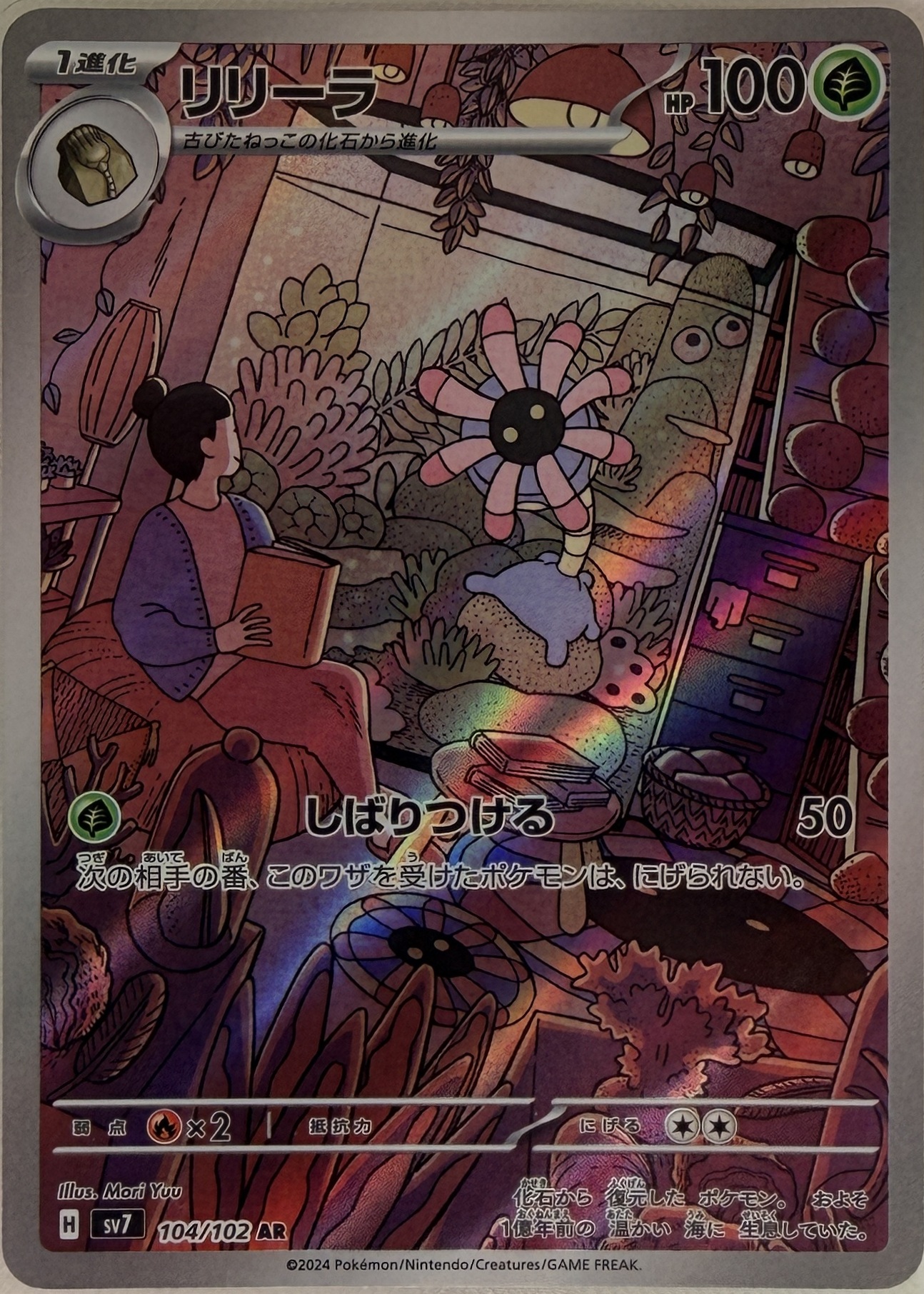
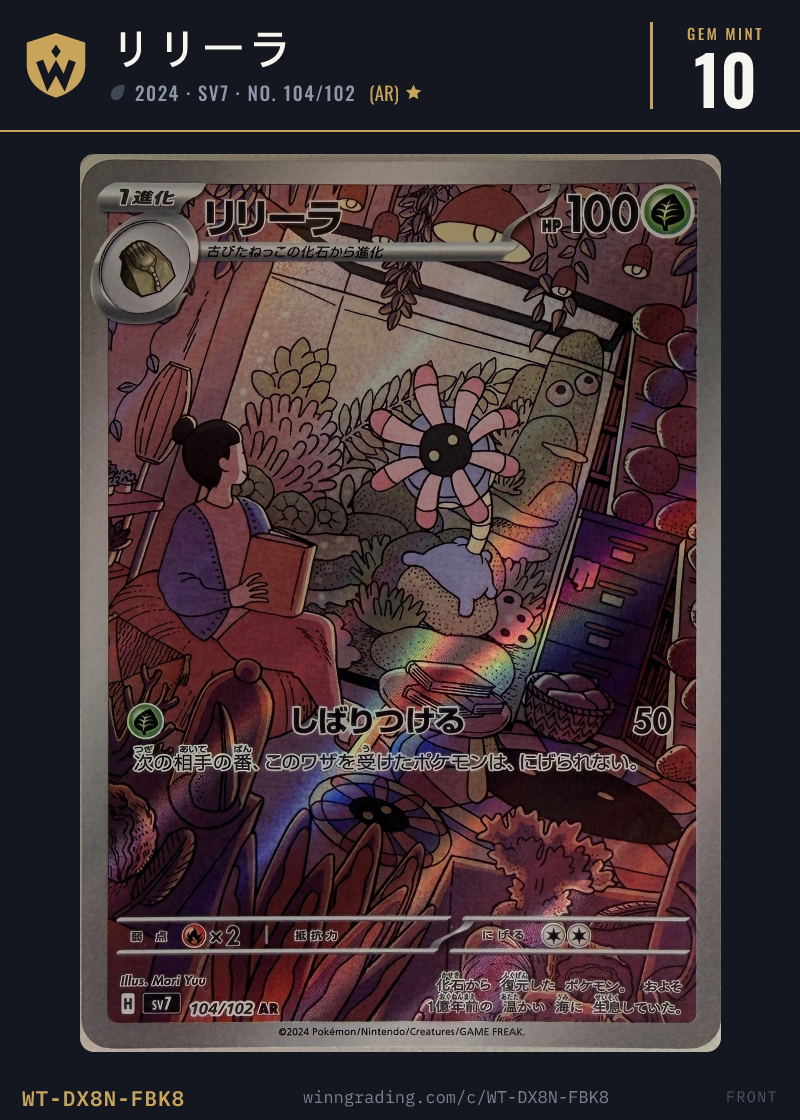
This is Lileep from the Stellar Miracle set, numbered 104 out of 102 cards, printed as an AR (Art Rare) variant. The artwork by Mori Yuu depicts a person seated and reading in a cluttered, plant-filled room, with a holographic Lileep and other fossil Pokemon rendered among the furnishings. The card is a Stage 1 Pokemon evolving from Lileep's pre-evolution, printed in Japanese for the 2024 release.
How it plays
This card has 100 HP and is a Grass-type Stage 1 Pokemon evolving from an old root fossil. Its attack, Shibaritsukeru, costs a single Grass energy and deals 50 damage, with the effect that the Pokemon hit cannot retreat during the opponent's next turn. It has a weakness to Fire-type attacks (x2), no listed resistance, and a retreat cost of two energy.
Written with AI from the card and its catalogue entry, and checked by WinnTCG.
Share this card
An image of the graded card, sized for eBay and social posts. The grade, the certificate number and the verification link travel with it.

Card details confirmed
A card with this name and number exists in the public card catalogue, in ステラミラクル, a set of 102 cards. The details on this certificate match it.
A catalogue match is not the authenticity check. It confirms the card is the card it claims to be. Whether it is genuine was checked separately, on the card itself; see Authenticity below.
About this card
#345 in the National Pokédex · a Generation III Pokémon · 48 different cards of it exist.
化石から 復元した ポケモン。 およそ 1億年前の 温かい 海に 生息していた。
From the card and the public catalogue, not written by WinnTCG.
Authenticity
WinnTCG authenticated this card in hand, on the bench, against genuine Pokémon cards. It was checked four ways: light shone through it to check the core, its weight on a scale, its thickness measured, and its print pattern and surface texture under magnification.
How this card was graded
WinnTCG graded this card in hand, on the bench. The card was in our hands, and we sealed the case ourselves. We photographed it here under controlled light to show which card is in the case and where anything we marked sits on it.
If you are buying this slab: the grade is WinnTCG’s judgement of the card that was in front of us, and WinnTCG sealed this case. The photographs above are of that card. Compare them against what you can see through the case, because a case can be opened by anyone who has held it since.
The working behind this grade
Every grade here is published with its reasoning. The report states what each measurement returned, what the model proposed on each axis, where the grader disagreed with it, and every defect marked on the photographs above.