

Character info
The character
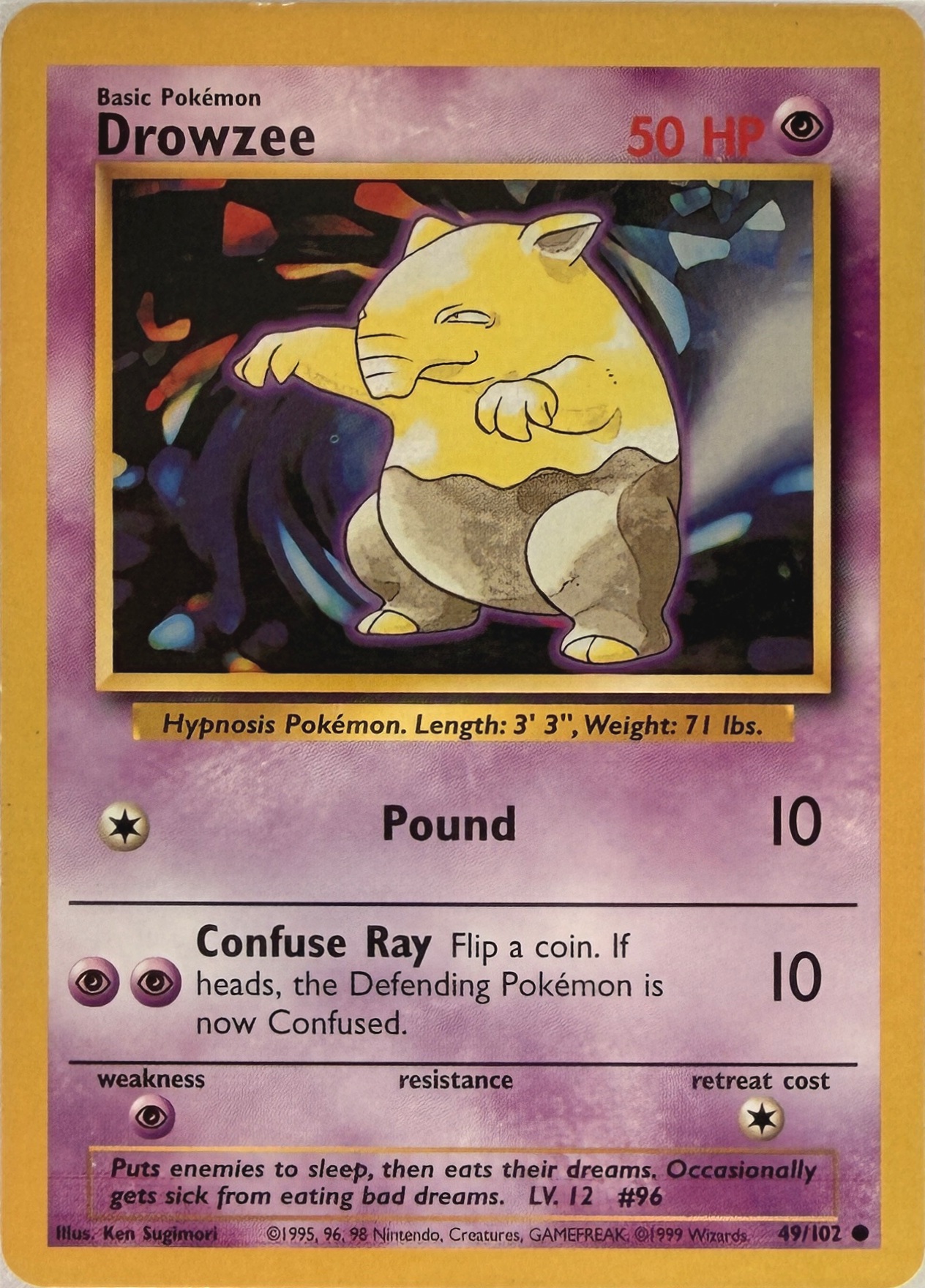
Drowzee is the Hypnosis Pokemon, known in the Pokemon series for putting people and other Pokemon to sleep so it can feed on their dreams. It is a Psychic-type creature that evolves into Hypno. Drowzee is recognized by its tapir-like appearance and trunk-like nose.
This card
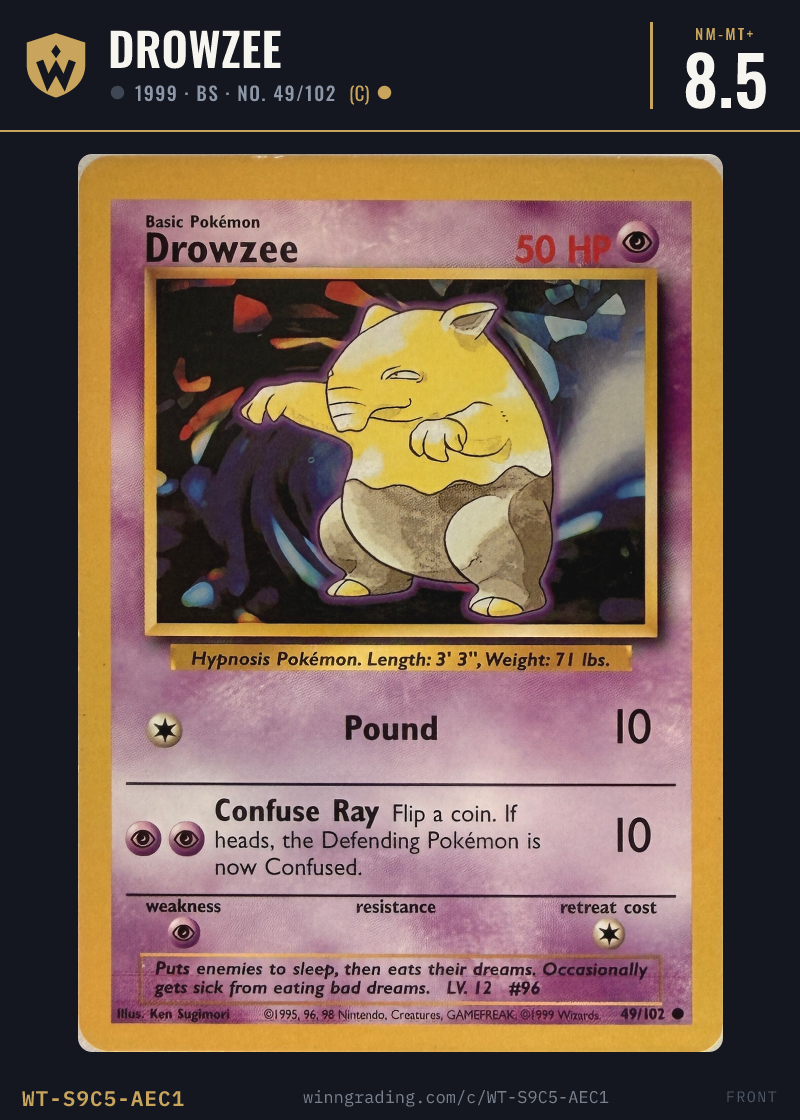
This card is from the Base Set, numbered 49 out of 102, printed in 1999 as a common card with the shadowless variant. The artwork, illustrated by Ken Sugimori, shows Drowzee standing with one arm raised against a dark, abstract background. The card displays the Pokedex entry describing its sleep and dream-eating habits.
How it plays
As a Basic Pokemon with 50 HP, this card has two attacks. Pound costs one Colorless Energy and deals 10 damage. Confuse Ray costs two Psychic Energy, deals 10 damage, and has a coin flip effect that confuses the Defending Pokemon on heads. It is weak to Psychic-type attacks and has a retreat cost of one Colorless Energy.
Written with AI from the card and its catalogue entry, and checked by WinnTCG.
Share this card
An image of the graded card, sized for eBay and social posts. The grade, the certificate number and the verification link travel with it.

Card details confirmed
A card with this name and number exists in the public card catalogue, in Base Set, a set of 102 cards, rarity C. The details on this certificate match it.
Illustrated by Ken Sugimori and published 1999-01-09. Both come from the public catalogue, not from WinnTCG.
A catalogue match is not the authenticity check. It confirms the card is the card it claims to be. Whether it is genuine was checked separately, on the card itself; see Authenticity below.
About this card
#96 in the National Pokédex · a Generation I Pokémon · 137 different cards of it exist.
Puts enemies to sleep, then eats their dreams. Occasionally gets sick from eating bad dreams.
From the card and the public catalogue, not written by WinnTCG.
Authenticity
WinnTCG authenticated this card in hand, on the bench, against genuine Pokémon cards. It was checked four ways: light shone through it to check the core, its weight on a scale, its thickness measured, and its print pattern and surface texture under magnification.
How this card was graded
WinnTCG graded this card in hand, on the bench. The card was in our hands, and we sealed the case ourselves. We photographed it here under controlled light to show which card is in the case and where anything we marked sits on it.
If you are buying this slab: the grade is WinnTCG’s judgement of the card that was in front of us, and WinnTCG sealed this case. The photographs above are of that card. Compare them against what you can see through the case, because a case can be opened by anyone who has held it since.
The working behind this grade
Every grade here is published with its reasoning. The report states what each measurement returned, what the model proposed on each axis, where the grader disagreed with it, and every defect marked on the photographs above.