
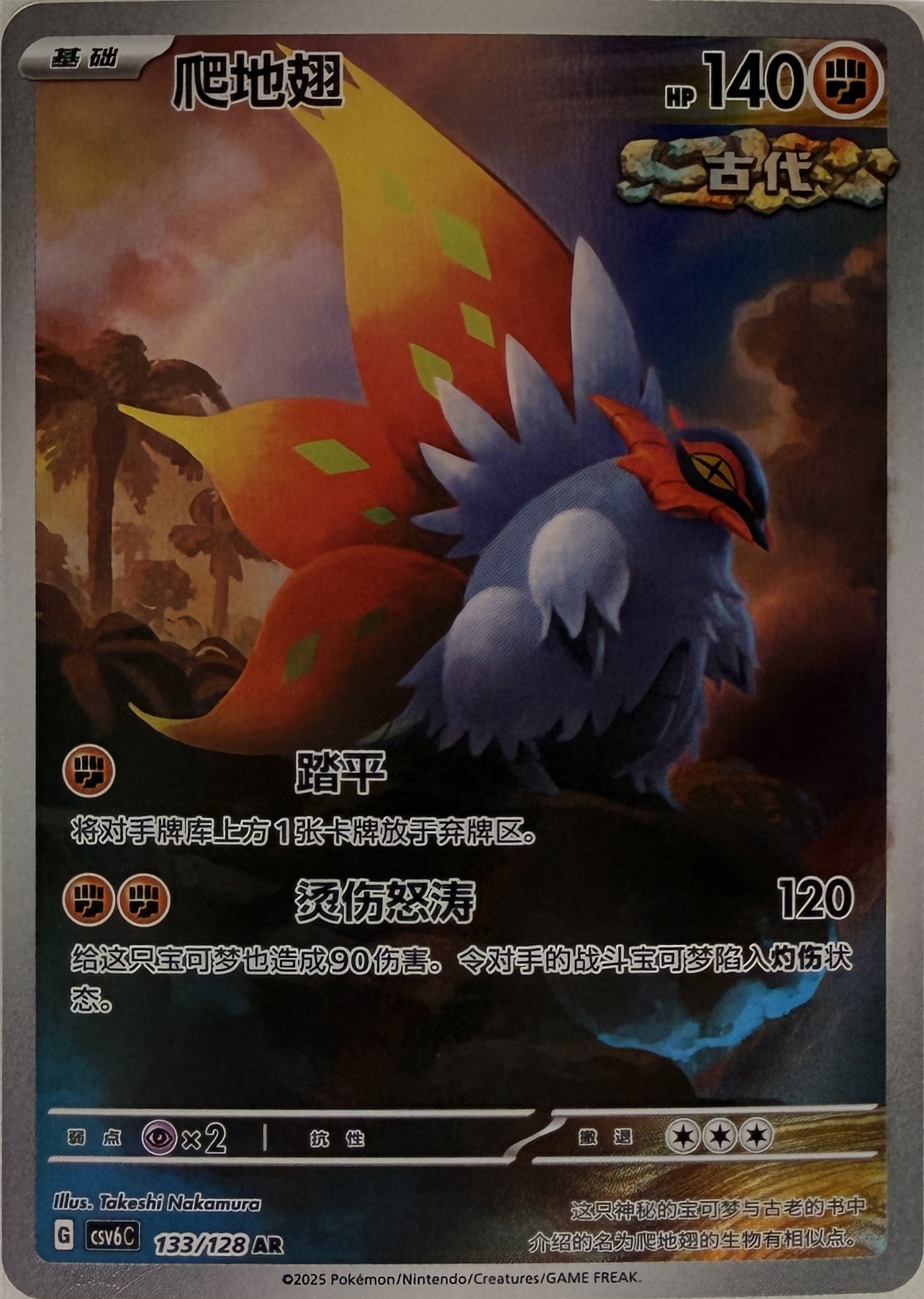

Character info
The character
Slither Wing is a Fighting-type Paradox Pokemon, an ancient counterpart linked to Volcarona that debuted in the Scarlet and Violet video games. It is depicted as a fierce, moth-like creature with a fiery wing on one side and a shaggy, bird-like body on the other. In the games it is known for raw physical power and aggressive behavior rather than special attacks.
This card
This is card 133/128, an AR (Alternate Rarity) secret rare from the Paradox Veil set (csv6C), illustrated by Takeshi Nakamura. The artwork shows Slither Wing perched on dark rock against a smoky, jungle-lit background, rendered in a full-art holo treatment that extends beyond the usual text box frame. The card text and layout are printed in Simplified Chinese.
How it plays
This Basic Pokemon has 140 HP and is Fighting type, with a Psychic weakness (x2) and a retreat cost of three. Its first attack, Stomp Flat (costing one Fighting energy), discards the top card of the opponent's deck. Its second attack, Scorching Scald Surge (costing two Fighting energy), deals 120 damage, also deals 90 damage to itself, and inflicts Burn on the opponent's Active Pokemon.
Written with AI from the card and its catalogue entry, and checked by WinnTCG.
Share this card
An image of the graded card, sized for eBay and social posts. The grade, the certificate number and the verification link travel with it.
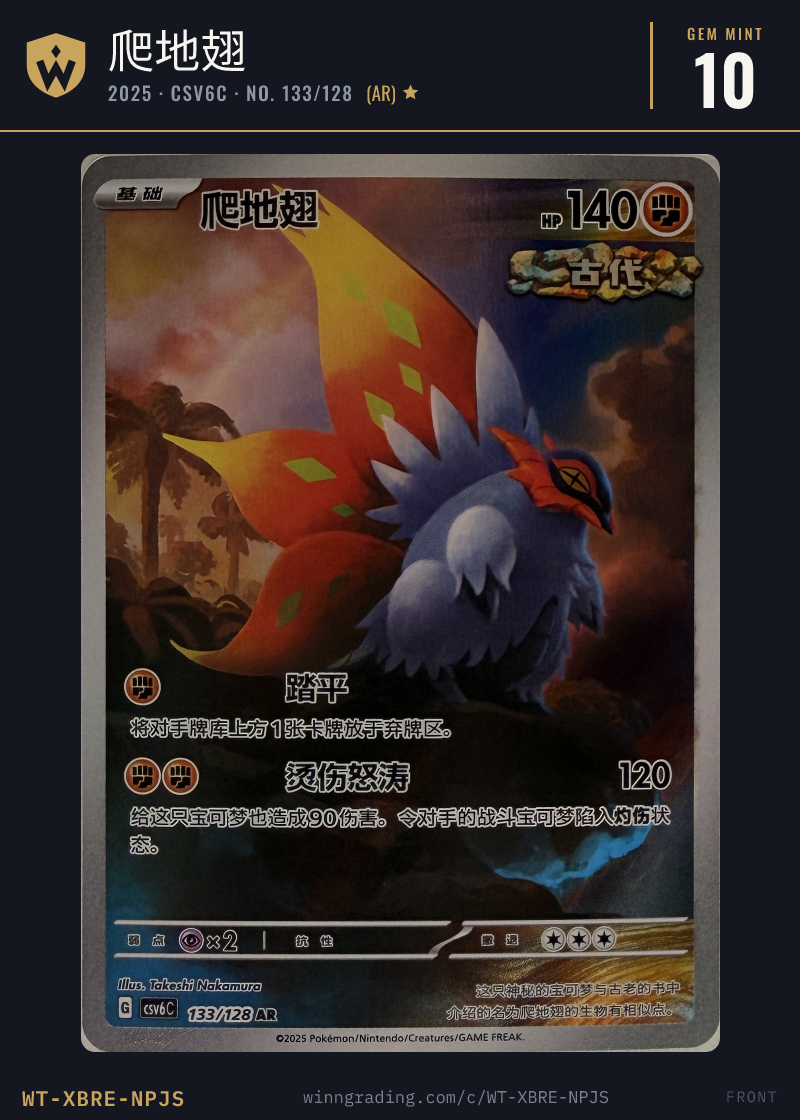

Authenticity
WinnTCG authenticated this card in hand, on the bench, against genuine Pokémon cards. It was checked four ways: light shone through it to check the core, its weight on a scale, its thickness measured, and its print pattern and surface texture under magnification.
How this card was graded
WinnTCG graded this card in hand, on the bench. The card was in our hands, and we sealed the case ourselves. We photographed it here under controlled light to show which card is in the case and where anything we marked sits on it.
If you are buying this slab: the grade is WinnTCG’s judgement of the card that was in front of us, and WinnTCG sealed this case. The photographs above are of that card. Compare them against what you can see through the case, because a case can be opened by anyone who has held it since.
The working behind this grade
Every grade here is published with its reasoning. The report states what each measurement returned, what the model proposed on each axis, where the grader disagreed with it, and every defect marked on the photographs above.