

Character info
The character
Charmander is a Fire-type Pokémon known as the Lizard Pokémon, first introduced as one of the three original starter Pokémon in the Kanto region. It prefers hot environments and keeps a flame burning at the tip of its tail, a flame said to reflect its emotions and vitality. Charmander evolves into Charmeleon and eventually into Charizard.
This card
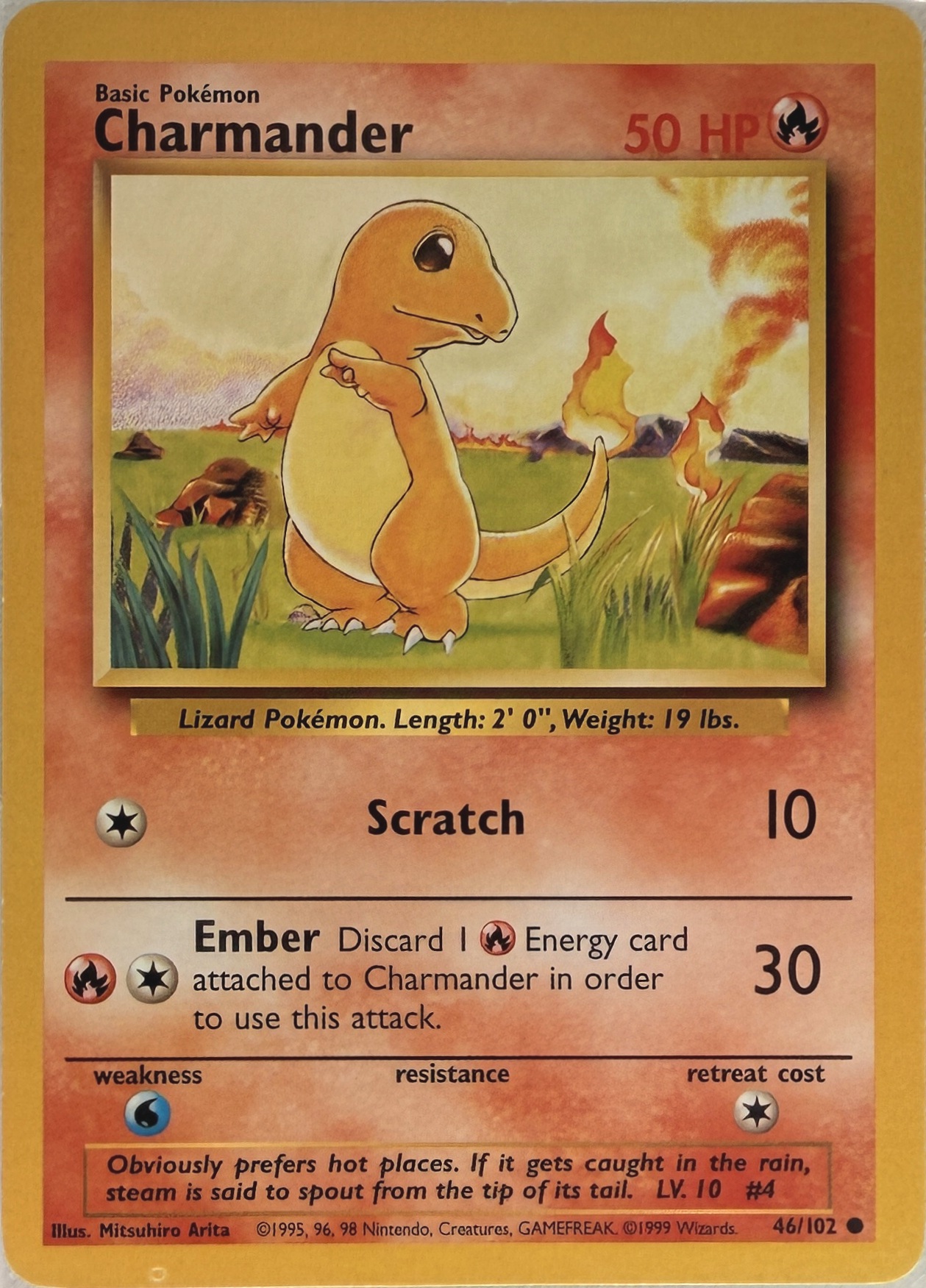
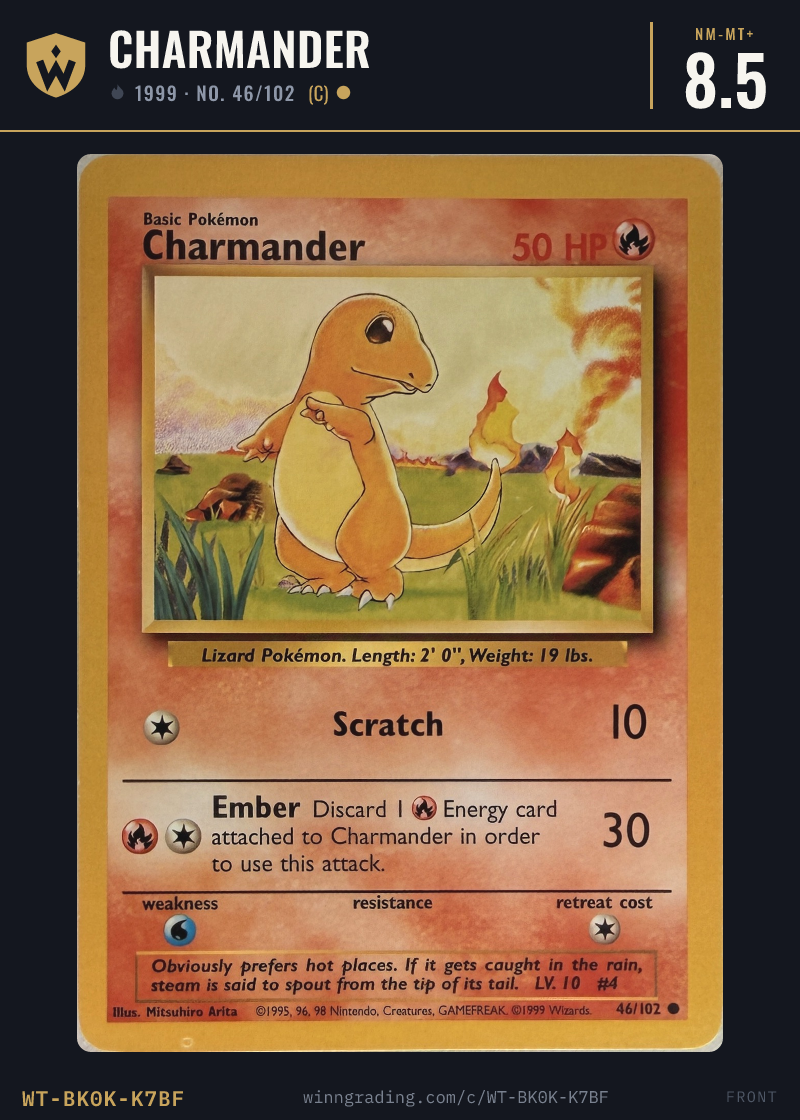
This is Charmander, numbered 46 out of 102 cards in the Pokémon Base Set, printed in 1999 as a common card. The artwork, illustrated by Mitsuhiro Arita, shows Charmander standing in a grassy field with distant fires and smoke rising in the background. The card carries the standard common rarity symbol and the early Wizards of the Coast copyright line.
How it plays
This is a Basic Pokémon with 50 HP and the Fire type. It has two attacks: Scratch, costing one Colorless Energy, deals 10 damage; Ember, costing one Fire Energy and one Colorless Energy, deals 30 damage but requires discarding one Fire Energy card attached to Charmander to use. Charmander is weak to Water-type attacks, has no listed resistance, and has a retreat cost of one Colorless Energy.
Written with AI from the card and its catalogue entry, and checked by WinnTCG.
Share this card
An image of the graded card, sized for eBay and social posts. The grade, the certificate number and the verification link travel with it.

Card details confirmed
A card with this name and number exists in the public card catalogue, in Base Set, a set of 102 cards, rarity C. The details on this certificate match it.
Illustrated by Mitsuhiro Arita and published 1999-01-09. Both come from the public catalogue, not from WinnTCG.
A catalogue match is not the authenticity check. It confirms the card is the card it claims to be. Whether it is genuine was checked separately, on the card itself; see Authenticity below.
About this card
#4 in the National Pokédex · a Generation I Pokémon · 243 different cards of it exist.
Obviously prefers hot places. If it gets caught in the rain, steam is said to spout from the tip of its tail.
From the card and the public catalogue, not written by WinnTCG.
Authenticity
WinnTCG authenticated this card in hand, on the bench, against genuine Pokémon cards. It was checked four ways: light shone through it to check the core, its weight on a scale, its thickness measured, and its print pattern and surface texture under magnification.
How this card was graded
WinnTCG graded this card in hand, on the bench. The card was in our hands, and we sealed the case ourselves. We photographed it here under controlled light to show which card is in the case and where anything we marked sits on it.
If you are buying this slab: the grade is WinnTCG’s judgement of the card that was in front of us, and WinnTCG sealed this case. The photographs above are of that card. Compare them against what you can see through the case, because a case can be opened by anyone who has held it since.
The working behind this grade
Every grade here is published with its reasoning. The report states what each measurement returned, what the model proposed on each axis, where the grader disagreed with it, and every defect marked on the photographs above.