
Verification
Every slab carries a certificate number and a QR code. The number reads like 2611023-4738-2955 (older slabs carry a code like WT-7K3M-92QH), and scanning it, or typing it in, takes you straight to a page showing the card, the grade, all four sub-grades, and the photographs of the card.
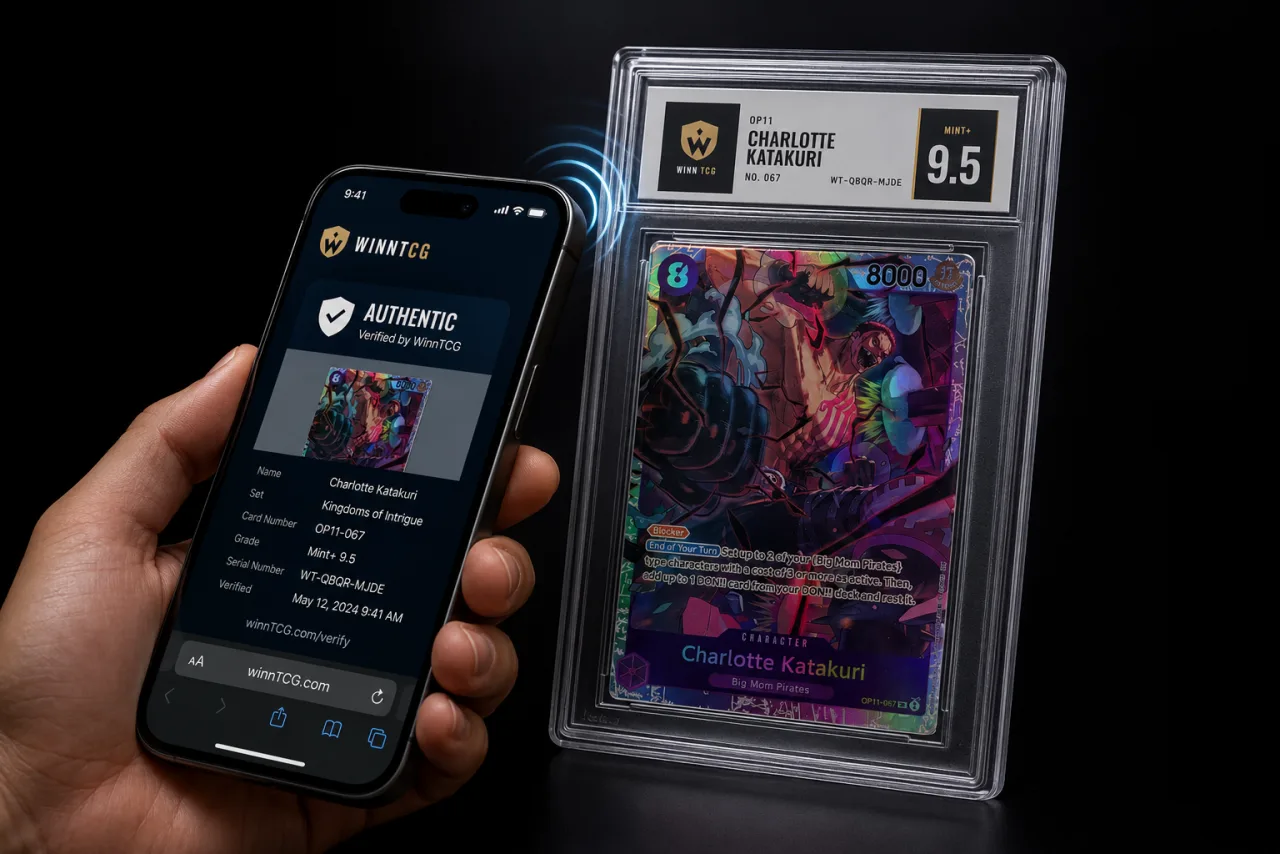
Tap it with your phone. That’s the whole interaction.
There’s an NFC chip in every label. Someone taps it and your certificate opens: the grade, all four sub-grades, and the photographs of the card. No app, no typing a code, no holding a phone three inches from a slab under a card shop’s lighting while somebody waits. There’s a QR code too, for the tap-averse.
The photographs matter more than anything printed
Everything else on this page repeats what is already on the label, and a copied certificate number can imitate all of it. What a copied number cannot give you is a card that matches these photographs. They were taken from one specific card, so a mismatch shows up the second you hold one against the other.
That comparison is yours to make, and it is worth making even though we sealed the case ourselves: a case can be opened by anyone who has held it since. Set the two side by side before you rely on the grade. It takes ten seconds and it is the only check nobody can fake for you.
Check whether it was graded at all
Not every WinnTCG case carries a grade. WinnTCG Sealed is a card we photographed and encapsulated without assessing it: no grade, no sub-grades, and no opinion on its condition. The certificate says so in as many words, at the top of the page, where the grade would otherwise be.
This matters most if you are buying a slab from a stranger. A WinnTCG case is not by itself a statement that the card was graded, and the certificate is the only place that story is written down. If the page says sealed, nobody here has judged the card and the photographs are the whole of what we are vouching for.
What your certificate number tells you
New slabs carry a fifteen-digit number. The first seven digits say when the card was graded and which label it wears, so if we ever have to recall a batch, you can check your slab at a glance. The rest is drawn at random and ends in a check digit, so a mistyped number is caught instead of leading to someone else's card. Older slabs keep the WT- code they were sealed with, and it works exactly as it always has.
How long it keeps answering
The address is sealed inside a plastic case, so it has to answer for as long as the slab exists, longer than any server involved in grading it. That's why the certificate page is built so that nothing behind the scenes can take it down.